
Quiz Summary
0 of 25 Questions completed
Questions:
Information
You have already completed the quiz before. Hence you can not start it again.
Quiz is loading…
You must sign in or sign up to start the quiz.
You must first complete the following:
Results
Results
0 of 25 Questions answered correctly
Your time:
Time has elapsed
You have reached 0 of 0 point(s), (0)
Earned Point(s): 0 of 0, (0)
0 Essay(s) Pending (Possible Point(s): 0)
Categories
- Not categorized 0%
- 1
- 2
- 3
- 4
- 5
- 6
- 7
- 8
- 9
- 10
- 11
- 12
- 13
- 14
- 15
- 16
- 17
- 18
- 19
- 20
- 21
- 22
- 23
- 24
- 25
- Current
- Review
- Answered
- Correct
- Incorrect
-
Question 1 of 25
1. Question
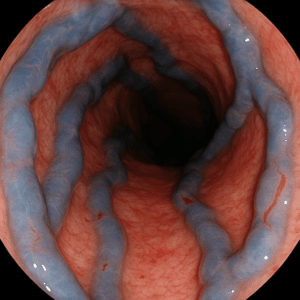
endoscopic image showing dilated, tortuous bluish veins in the distal esophagus protruding into the lumen, some with red wale markings.
What is the most likely diagnosis based on the image?
CorrectIncorrect -
Question 2 of 25
2. Question
Which of the following best describes the pathological features of liver cirrhosis?
CorrectIncorrect -
Question 3 of 25
3. Question
Which of the following best describes the underlying pathology of Mallory-Weiss syndrome?
CorrectIncorrect -
Question 4 of 25
4. Question
Acute pancreatitis is most commonly initiated by:
CorrectIncorrect -
Question 5 of 25
5. Question
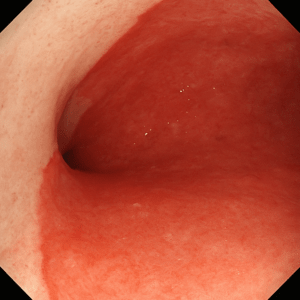
An endoscopic image reveals a segment of the distal esophagus with velvety, reddish “salmon-pink” mucosa extending above the gastroesophageal junction.
What is the most likely diagnosis?
CorrectIncorrect -
Question 6 of 25
6. Question
GERD most commonly results from which of the following mechanisms?
CorrectIncorrect -
Question 7 of 25
7. Question
Which of the following best characterizes obstructive (post-hepatic) jaundice?
CorrectIncorrect -
Question 8 of 25
8. Question
A 17-year-old male presents with tremors, personality changes, and mild jaundice.
On exam, he has hepatomegaly and a golden-brown ring around the cornea.
Which test will most likely confirm the diagnosis?
CorrectIncorrect -
Question 9 of 25
9. Question
A patient with inflammatory bowel disease develops a toxic megacolon. This complication is more commonly associated with:
CorrectIncorrect -
Question 10 of 25
10. Question
A 54-year-old woman presents with dry mouth and gritty sensation in her eyes for several months.
On exam, she has bilateral parotid gland enlargement.
A Schirmer test is positive.
Which of the following is the most likely diagnosis?
CorrectIncorrect -
Question 11 of 25
11. Question
Which of the following are the most common causes of peptic ulcer disease worldwide? (Multiple option question)
CorrectIncorrect -
Question 12 of 25
12. Question
A 40-year-old man presents with a 2-month history of burning epigastric pain.
The pain typically occurs 2–3 hours after meals and sometimes wakes him up at night.
He finds temporary relief after eating or taking antacids.
He denies weight loss, but occasionally experiences bloating.
Which of the following is the most likely diagnosis?
CorrectIncorrect -
Question 13 of 25
13. Question
Which dietary component triggers the autoimmune reaction in celiac disease?
CorrectIncorrect -
Question 14 of 25
14. Question
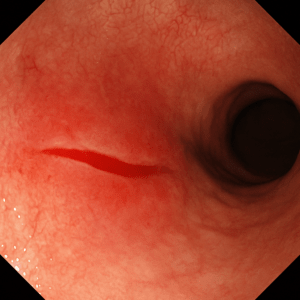
Endoscopic image showing a fresh linear tear with surrounding erythema at the gastroesophageal junction, no active bleeding visible.
what is the most likely diagnosis based on this image ?
CorrectIncorrect -
Question 15 of 25
15. Question
patient arrives with severe upper abdominal pain radiating to the back, nausea, and vomiting.
Lab tests show abnormalities in pancreatic enzymes and calcium levels.
Which of the following lab findings is typically seen in acute pancreatitis?
CorrectIncorrect -
Question 16 of 25
16. Question
A 10-year-old boy presents with facial swelling and cola-colored urine.
He had a recent history of a streptococcal throat infection.
Urinalysis shows hematuria with red blood cell casts and mild proteinuria.
A kidney biopsy reveals glomerular hypercellularity and immune complex deposition.
What is the most likely underlying mechanism responsible for his renal injury?
CorrectIncorrect -
Question 17 of 25
17. Question
Which of the following mechanisms best explains the development of Barrett’s esophagus?
CorrectIncorrect -
Question 18 of 25
18. Question
A 52-year-old woman presents with chronic heartburn, especially after meals and when lying down.
She also reports a sour taste in her mouth and occasional hoarseness.
She denies any weight loss or difficulty swallowing.
What is the next best step in her management?
CorrectIncorrect -
Question 19 of 25
19. Question
A 32-year-old man presents with fatigue, jaundice, and dark urine for the past week.
He recently had unprotected sexual contact.
Laboratory testing reveals positive hepatitis B surface antigen (HBsAg) and IgM antibodies to hepatitis B core antigen (anti-HBc IgM).
Which of the following best describes the current stage of his hepatitis B infection?
CorrectIncorrect -
Question 20 of 25
20. Question
Which of the following skin findings is most characteristically associated with cirrhosis?
CorrectIncorrect -
Question 21 of 25
21. Question
A biopsy from a patient with chronic inflammatory bowel disease shows noncaseating granulomas and transmural inflammation. Which disease is most consistent with this finding?
CorrectIncorrect -
Question 22 of 25
22. Question
A small intestinal biopsy from a patient with chronic diarrhea reveals villous atrophy, crypt hyperplasia, and increased intraepithelial lymphocytes. Which condition is most consistent with these findings?
CorrectIncorrect -
Question 23 of 25
23. Question
Which of the following laboratory findings is most consistent with Wilson’s disease?
CorrectIncorrect -
Question 24 of 25
24. Question
A 45-year-old woman has jaundice, elevated AST and ALT, and high unconjugated bilirubin.
Alkaline phosphatase is normal.
What is the most likely cause?
CorrectIncorrect -
Question 25 of 25
25. Question
Which of the following is the hallmark laboratory finding in nephrotic syndrome?
CorrectIncorrect