
Quiz Summary
0 of 7 Questions completed
Questions:
Information
You have already completed the quiz before. Hence you can not start it again.
Quiz is loading…
You must sign in or sign up to start the quiz.
You must first complete the following:
Results
Results
0 of 7 Questions answered correctly
Your time:
Time has elapsed
You have reached 0 of 0 point(s), (0)
Earned Point(s): 0 of 0, (0)
0 Essay(s) Pending (Possible Point(s): 0)
Categories
- Not categorized 0%
- 1
- 2
- 3
- 4
- 5
- 6
- 7
- Current
- Review
- Answered
- Correct
- Incorrect
-
Question 1 of 7
1. Question
Why is routine use of sharp explorers discouraged for diagnosing early enamel caries?
CorrectIncorrect -
Question 2 of 7
2. Question
A 34-year-old woman reports tooth sensitivity and presents with smooth, cupped-out depressions on the palatal surfaces of her maxillary anterior teeth. She has a history of chronic gastroesophageal reflux disease (GERD).
What is the most likely cause of these lesions?
CorrectIncorrect -
Question 3 of 7
3. Question
Which of the following best explains the mechanism of dentin hypersensitivity?
CorrectIncorrect -
Question 4 of 7
4. Question
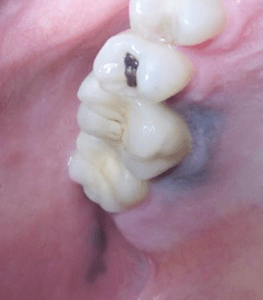
A 45-year-old patient presents with a pigmented lesion on the posterior alveolar mucosa, adjacent to a molar with an existing restoration. The lesion is asymptomatic, flat, and bluish-gray in appearance. There is no reported history of trauma or systemic pigmentation disorders.
Which of the following is the most likely diagnosis?
CorrectIncorrect -
Question 5 of 7
5. Question
A 52-year-old patient presents with V-shaped notches at the cervical areas of multiple premolars. The lesions are hard, smooth, and not sensitive to percussion. The patient brushes aggressively using a hard-bristled toothbrush.
What is the most likely diagnosis?
CorrectIncorrect -
Question 6 of 7
6. Question
Why is air drying useful in the visual detection of early enamel caries?
CorrectIncorrect -
Question 7 of 7
7. Question
Which of the following are included in Keyes’ original triad for dental caries development?
(Multiple Correct Answers)
CorrectIncorrect