
Quiz Summary
0 of 8 Questions completed
Questions:
Information
You have already completed the quiz before. Hence you can not start it again.
Quiz is loading…
You must sign in or sign up to start the quiz.
You must first complete the following:
Results
Results
0 of 8 Questions answered correctly
Your time:
Time has elapsed
You have reached 0 of 0 point(s), (0)
Earned Point(s): 0 of 0, (0)
0 Essay(s) Pending (Possible Point(s): 0)
Categories
- Not categorized 0%
- 1
- 2
- 3
- 4
- 5
- 6
- 7
- 8
- Current
- Review
- Answered
- Correct
- Incorrect
-
Question 1 of 8
1. Question
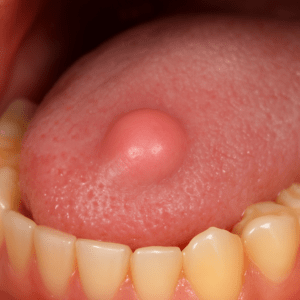
A 38-year-old patient presents with a solitary, dome-shaped, smooth, firm, pink nodule on the tongue. The lesion is non-ulcerated and has been present for several months without change in size. The patient reports no pain or discomfort. Based on this clinical presentation, what is the most likely diagnosis?
CorrectIncorrect -
Question 2 of 8
2. Question
Which of the following drugs is most commonly associated with gingival hyperplasia?
CorrectIncorrect -
Question 3 of 8
3. Question
Neurofibroma is a benign tumor originating from:
CorrectIncorrect -
Question 4 of 8
4. Question
Which of the following tumor-to-description matches is INCORRECT?
CorrectIncorrect -
Question 5 of 8
5. Question
Match the feature With its association 1. Café-au-lait spots A. Pigmented iris hamartomas 2. Lisch nodules B. Hyperpigmented skin macules 3. Plexiform neurofibroma C. “Bag of worms” texture; risk of malignancy 4. Gingival neurofibroma D. Oral manifestation of NF1 CorrectIncorrect -
Question 6 of 8
6. Question
A 42-year-old patient presents with a slow-growing, firm, painless nodule on the tongue. The lesion is encapsulated and has been present for 1 year without ulceration. Histology reveals palisading nuclei arranged around acellular zones (Verocay bodies). What is the most likely diagnosis?
CorrectIncorrect -
Question 7 of 8
7. Question
What is the typical clinical course of nodular fasciitis?
CorrectIncorrect -
Question 8 of 8
8. Question
Which of the following is the most common intraoral site for Kaposi’s sarcoma?
CorrectIncorrect