
Quiz Summary
0 of 25 Questions completed
Questions:
Information
You have already completed the quiz before. Hence you can not start it again.
Quiz is loading…
You must sign in or sign up to start the quiz.
You must first complete the following:
Results
Results
0 of 25 Questions answered correctly
Your time:
Time has elapsed
You have reached 0 of 0 point(s), (0)
Earned Point(s): 0 of 0, (0)
0 Essay(s) Pending (Possible Point(s): 0)
Categories
- Not categorized 0%
- 1
- 2
- 3
- 4
- 5
- 6
- 7
- 8
- 9
- 10
- 11
- 12
- 13
- 14
- 15
- 16
- 17
- 18
- 19
- 20
- 21
- 22
- 23
- 24
- 25
- Current
- Review
- Answered
- Correct
- Incorrect
-
Question 1 of 25
1. Question
A 9-year-old boy presents with a midline diastema and proclined maxillary incisors. On examination, he has a retained maxillary primary canine and a class I molar relationship. What is the most likely the cause of his midline diastema?
CorrectIncorrect -
Question 2 of 25
2. Question
A 7-year-old girl presents with anterior crossbite involving permanent maxillary central incisors. The molars are in a class I relationship. Which of the following is the most appropriate timing for intervention?
CorrectIncorrect -
Question 3 of 25
3. Question
A 12-year-old boy presents with crowding in the lower anterior segment. On radiographs, his second molars are erupting, and his growth spurt is almost complete. Which of the following is the best treatment strategy?
CorrectIncorrect -
Question 4 of 25
4. Question
A 13-year-old female patient presents with a skeletal Class II malocclusion. Cephalometric evaluation shows the mandible is retrusive. What should be considered when timing functional appliance therapy?
CorrectIncorrect -
Question 5 of 25
5. Question
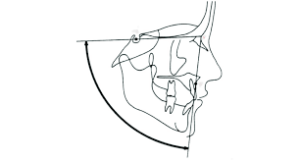
Which of the following angle corresponds to the one illustrated in provided Cephalometric image
CorrectIncorrect -
Question 6 of 25
6. Question
Which of the following is an example of absolute anchorage in orthodontics?
CorrectIncorrect -
Question 7 of 25
7. Question
Which property is primarily responsible for the ability of a wire to bend without fracturing?
CorrectIncorrect -
Question 8 of 25
8. Question
Which of the following primary molar relationships is most likely to transition into a Class I molar relationship in the permanent dentition?
CorrectIncorrect -
Question 9 of 25
9. Question
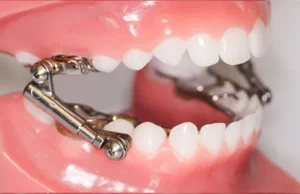
Which of the following best describes the primary purpose of the appliance shown in the image?
 CorrectIncorrect
 -
Question 10 of 25
10. Question
Which of the following complications at birth is associated with Pierre Robin Sequence?
CorrectIncorrect -
Question 11 of 25
11. Question
Which of the following is not a characteristic of condylar growth?
CorrectIncorrect -
Question 12 of 25
12. Question
Which of the following is considered a functional matrix according to Moss’s Functional Matrix Theory?
CorrectIncorrect -
Question 13 of 25
13. Question
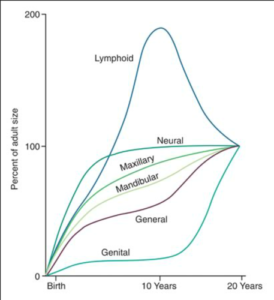
Based on the image, which of the following is true regarding mandibular growth?
CorrectIncorrect -
Question 14 of 25
14. Question
Which among the following is the most likely occlusal issue in a patient with an unrepaired cleft palate?
CorrectIncorrect -
Question 15 of 25
15. Question
Which of the following correctly represents the Tanaka-Johnston prediction for the maxillary arch (one side)?
CorrectIncorrect -
Question 16 of 25
16. Question
What is the treatment of choice for a 7-year-old child with bilateral posterior crossbite due to maxillary constriction?
CorrectIncorrect -
Question 17 of 25
17. Question
Which of the following is a potential side effect of serial extraction if not followed by proper orthodontic intervention?
CorrectIncorrect -
Question 18 of 25
18. Question
A 9-year-old patient presents with a 2 mm midline diastema between the maxillary central incisors. What is the most appropriate approach using reciprocal anchorage?
CorrectIncorrect -
Question 19 of 25
19. Question
Which diagnostic factor most strongly favors a non-extraction approach in a borderline case of moderate crowding (~5 mm)?
CorrectIncorrect -
Question 20 of 25
20. Question
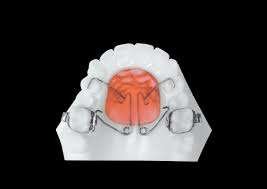
What is the primary function of the appliance shown in the image?
CorrectIncorrectHint
-
Question 21 of 25
21. Question
What is the primary purpose of Bolton’s Analysis?
CorrectIncorrect -
Question 22 of 25
22. Question
What is the primary characteristic of frontal resorption during orthodontic tooth movement?
CorrectIncorrect -
Question 23 of 25
23. Question
What does the Mc/Mf ratio determine during orthodontic tooth movement?
CorrectIncorrect -
Question 24 of 25
24. Question
Which of the following is a characteristic of Angle’s Class III malocclusion?
CorrectIncorrect -
Question 25 of 25
25. Question
What clinical sign often confirms successful midpalatal suture opening after Hyrax activation?
CorrectIncorrect