
Quiz Summary
0 of 25 Questions completed
Questions:
Information
You have already completed the quiz before. Hence you can not start it again.
Quiz is loading…
You must sign in or sign up to start the quiz.
You must first complete the following:
Results
Results
0 of 25 Questions answered correctly
Your time:
Time has elapsed
You have reached 0 of 0 point(s), (0)
Earned Point(s): 0 of 0, (0)
0 Essay(s) Pending (Possible Point(s): 0)
Categories
- Not categorized 0%
- 1
- 2
- 3
- 4
- 5
- 6
- 7
- 8
- 9
- 10
- 11
- 12
- 13
- 14
- 15
- 16
- 17
- 18
- 19
- 20
- 21
- 22
- 23
- 24
- 25
- Current
- Review
- Answered
- Correct
- Incorrect
-
Question 1 of 25
1. Question
Why etching time required more in primary teeth than permanent teeth?
CorrectIncorrect -
Question 2 of 25
2. Question
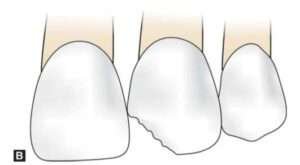
Which of the following G.V. Black classifications best describes the image shown?
CorrectIncorrect -
Question 3 of 25
3. Question
Which of the following method is used for early detection of incipient proximal caries?
CorrectIncorrect -
Question 4 of 25
4. Question
Run-out of a bur is:
CorrectIncorrect -
Question 5 of 25
5. Question
What is the primary reason for using glass ionomer cement in the sandwich technique?
CorrectIncorrect -
Question 6 of 25
6. Question
Which of the following cavity preparations has maximum C-factor?
CorrectIncorrect -
Question 7 of 25
7. Question
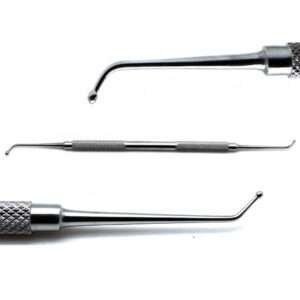
Which of the following correctly describes the instrument shown in the image?
CorrectIncorrect -
Question 8 of 25
8. Question
Which among the following statements are true about dentin bonding agents?
(Multiple Correct Answers)
CorrectIncorrect -
Question 9 of 25
9. Question
Statement 1: Caries in fissures reach pulp faster than the smooth surfaces
Statement 2: Carious lesions on smooth surfaces take 6 months to reach pulpCorrectIncorrect -
Question 10 of 25
10. Question
On a carbide bur, a great number of cutting blades results in:
CorrectIncorrect -
Question 11 of 25
11. Question
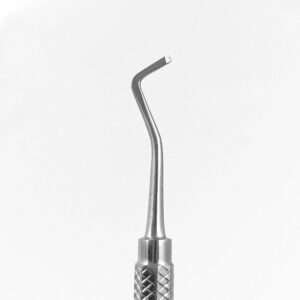
Which of the following correctly describes the design and construction of the instrument given in the image?
CorrectIncorrect -
Question 12 of 25
12. Question
Arrange the following steps of cavity preparation in their correct order:
-
Retention form
-
Toilet of the cavity
-
Removal of remaining caries
-
Outline form
-
Resistance form
-
Final finishing of cavity walls and margins
View Answers:
CorrectIncorrect -
-
Question 13 of 25
13. Question
In a cavity prepared for composite restoration, Calcium hydroxide has been placed as a liner. Which of the following should be applied as a base for protecting the cavity?
CorrectIncorrect -
Question 14 of 25
14. Question
Which of the following is included in diet counselling to reduce caries?
CorrectIncorrect -
Question 15 of 25
15. Question
The encircled number in the given instrument formula 10-(80)-4-12 represents:
CorrectIncorrect -
Question 16 of 25
16. Question
Fiber-optic trans-illumination (FOTI) method of caries diagnosis is based on the principle of:
CorrectIncorrect -
Question 17 of 25
17. Question
A diagnosis of small occlusal cavities is most readily made by:
CorrectIncorrect -
Question 18 of 25
18. Question
Which of the following statements about affected dentin are true?
(Multiple Correct Answers)
CorrectIncorrect -
Question 19 of 25
19. Question
“Right rear” operator position refers to:
CorrectIncorrect -
Question 20 of 25
20. Question
For the balance of hand cutting instrument:
CorrectIncorrect -
Question 21 of 25
21. Question
What is the primary reason for using high‑copper amalgam alloys?
CorrectIncorrect -
Question 22 of 25
22. Question
Which of the following restorations are preferred for root surface caries?
CorrectIncorrect -
Question 23 of 25
23. Question
In mechanical trituration of amalgam, what is adversely affected?CorrectIncorrect -
Question 24 of 25
24. Question
Deepening the pulpal floor during cavity preparation provides for:
CorrectIncorrect -
Question 25 of 25
25. Question
With slowly advancing enamel caries and rapid involvement of dentin, the type of dentin formed is:
CorrectIncorrect