
Quiz Summary
0 of 25 Questions completed
Questions:
Information
You have already completed the quiz before. Hence you can not start it again.
Quiz is loading…
You must sign in or sign up to start the quiz.
You must first complete the following:
Results
Results
0 of 25 Questions answered correctly
Your time:
Time has elapsed
You have reached 0 of 0 point(s), (0)
Earned Point(s): 0 of 0, (0)
0 Essay(s) Pending (Possible Point(s): 0)
Categories
- Not categorized 0%
- 1
- 2
- 3
- 4
- 5
- 6
- 7
- 8
- 9
- 10
- 11
- 12
- 13
- 14
- 15
- 16
- 17
- 18
- 19
- 20
- 21
- 22
- 23
- 24
- 25
- Current
- Review
- Answered
- Correct
- Incorrect
-
Question 1 of 25
1. Question
A 22-year-old patient presents with severe mandibular retrognathia, resulting in a Class II malocclusion and airway obstruction during sleep. Orthodontic treatment alone has been unsuccessful. Which surgical procedure is most appropriate to improve both occlusion and airway space?
CorrectIncorrect -
Question 2 of 25
2. Question
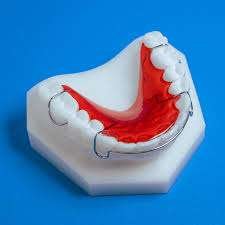
A 17-year-old patient recently completed fixed orthodontic treatment. The clinician provides the appliance shown in the image and instructs the patient to wear it nightly. What is the most likely long-term benefit of this protocol?
CorrectIncorrect -
Question 3 of 25
3. Question
Which of the following arch dimensions is considered most stable post-treatment?
CorrectIncorrect -
Question 4 of 25
4. Question
Which of the following types of tooth/jaw movement has the greatest limit when using orthodontic treatment alone, according to the envelope of discrepancy?
CorrectIncorrect -
Question 5 of 25
5. Question
Which of the following is a primary biological cause of orthodontic relapse?
CorrectIncorrect -
Question 6 of 25
6. Question
How is the image receptor positioned in the bisecting angle technique compared to paralleling technique?
CorrectIncorrect -
Question 7 of 25
7. Question
Characteristic radiation in an X-ray tube results from
CorrectIncorrect -
Question 8 of 25
8. Question
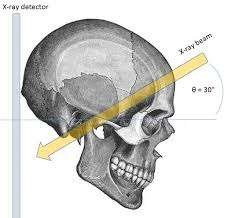
The radiographic projection shown is primarily used to visualize which of the following structures?
CorrectIncorrect -
Question 9 of 25
9. Question
Which of the following is true regarding collimation and image quality?
CorrectIncorrect -
Question 10 of 25
10. Question
A patient who underwent radiotherapy to the mandible needs a molar extraction. What is the best approach to reduce the risk of osteoradionecrosis?
CorrectIncorrect -
Question 11 of 25
11. Question
Which of the following is a key limitation of the paralleling technique?
CorrectIncorrect -
Question 12 of 25
12. Question
Which of the following mechanism forms the latent image on a dental X-ray film?
CorrectIncorrect -
Question 13 of 25
13. Question
What is the possible reason of a Cone-cut in periapical radiograph?
CorrectIncorrect -
Question 14 of 25
14. Question
Which clinical condition would benefit most from high-contrast radiographs (i.e., black-and-white with little gray)?
CorrectIncorrect -
Question 15 of 25
15. Question
Which of the following is the recommended operator position relative to the primary beam during X-ray exposure?
CorrectIncorrect -
Question 16 of 25
16. Question
Which of the following components of an X-ray film is responsible for converting X-ray photons into a visible image?
CorrectIncorrect -
Question 17 of 25
17. Question
What is the function of sodium thiosulfate in the fixer solution?
CorrectIncorrect -
Question 18 of 25
18. Question
Why should thyroid collars be used during dental radiography, especially in children?
CorrectIncorrect -
Question 19 of 25
19. Question
What is the main function of the copper stem in the anode assembly of an X-ray tube?
CorrectIncorrect -
Question 20 of 25
20. Question
What is the main function of the roller transport system in an automatic processor?
CorrectIncorrect -
Question 21 of 25
21. Question
Which of the following combination of settings would result in the highest patient dose?
CorrectIncorrect -
Question 22 of 25
22. Question
A radiograph appears too light with poor image contrast. What is the most likely cause?
CorrectIncorrect -
Question 23 of 25
23. Question
What is the effect of radiation on salivary glands during head and neck radiotherapy?
CorrectIncorrect -
Question 24 of 25
24. Question
Which chemical in the developer softens the gelatin to allow penetration of the reducing agents?
CorrectIncorrect -
Question 25 of 25
25. Question
For a dental X-ray unit operating at 70 kVp or higher, what is the minimum required total aluminum filtration?
CorrectIncorrect