
Quiz Summary
0 of 25 Questions completed
Questions:
Information
You have already completed the quiz before. Hence you can not start it again.
Quiz is loading…
You must sign in or sign up to start the quiz.
You must first complete the following:
Results
Results
0 of 25 Questions answered correctly
Your time:
Time has elapsed
You have reached 0 of 0 point(s), (0)
Earned Point(s): 0 of 0, (0)
0 Essay(s) Pending (Possible Point(s): 0)
Categories
- Not categorized 0%
- 1
- 2
- 3
- 4
- 5
- 6
- 7
- 8
- 9
- 10
- 11
- 12
- 13
- 14
- 15
- 16
- 17
- 18
- 19
- 20
- 21
- 22
- 23
- 24
- 25
- Current
- Review
- Answered
- Correct
- Incorrect
-
Question 1 of 25
1. Question
Which of the following complications most likely occurs during a tooth extraction in a patient with Paget’s disease of the maxilla?
CorrectIncorrect -
Question 2 of 25
2. Question
A 68-year-old postmenopausal woman presents with back pain and a history of vertebral compression fractures. Bone mineral density (BMD) via DEXA scan shows a T-score of –2.8.
What is the most likely diagnosis?
CorrectIncorrect -
Question 3 of 25
3. Question
A 45-year-old male presents with hip pain and an imaging study reveals a lobulated mass with ring-and-arc calcifications. Biopsy reveals malignant cartilage cells.
What is the diagnosis?
CorrectIncorrect -
Question 4 of 25
4. Question
Which structure, if underdeveloped congenitally, would most likely result in impaired GH secretion?
CorrectIncorrect -
Question 5 of 25
5. Question
A 3-year-old child presents with growth retardation, frontal bossing on skull, bowing of legs, and prominent costochondral junctions.
Which of the following is the most likely cause of these findings?
CorrectIncorrect -
Question 6 of 25
6. Question
Which of the following clinical or radiographic findings help differentiate fibrous dysplasia from other jaw lesions?
(Multiple choice question)
CorrectIncorrect -
Question 7 of 25
7. Question
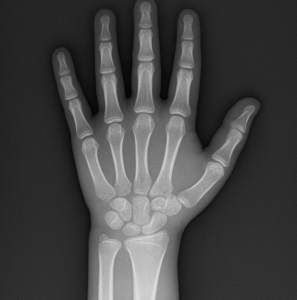
A left-hand X-ray of a 10-year-old boy shows open epiphyseal growth plates. The bone age appears closer to that of a 6-year-old, suggesting delayed skeletal development.
Based on the radiographic findings and the clinical presentation of short stature, which of the following is the most likely diagnosis?
CorrectIncorrect -
Question 8 of 25
8. Question
Which of the following distinguishes gigantism from acromegaly based on epiphyseal plate status?
CorrectIncorrect -
Question 9 of 25
9. Question
Which of the following radiographic findings is most characteristic of osteopetrosis?
CorrectIncorrect -
Question 10 of 25
10. Question
Which of the following best describes the underlying pathophysiology of type II diabetes mellitus?
CorrectIncorrect -
Question 11 of 25
11. Question
Which of the following radiographic features is more characteristic of chronic osteomyelitis than acute osteomyelitis?
CorrectIncorrect -
Question 12 of 25
12. Question
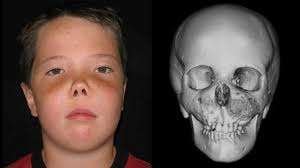
A 10-year-old child presents with painless facial swelling on the right side. A CT scan shows ground-glass opacity and expansion of the maxilla with obliteration of the maxillary sinus.
What is the most likely diagnosis?
CorrectIncorrect -
Question 13 of 25
13. Question
A patient with Cushing’s disease will most likely show which of the following laboratory findings?
CorrectIncorrect -
Question 14 of 25
14. Question
Which of the following are considered microvascular complications of diabetes mellitus?
CorrectIncorrect -
Question 15 of 25
15. Question
A 16-year-old boy presents with progressively worsening pain and swelling in the distal femur over the past two months. He has no history of trauma. On physical examination, there is a firm, tender mass above the knee.
X-ray of the femur reveals a mixed lytic and sclerotic lesion in the metaphysis, with periosteal elevation forming a Codman triangle and sunburst pattern. A biopsy confirms a high-grade malignant bone tumor.
Which of the following statements about this condition are TRUE?
(Select all that apply)
A. It most commonly arises in the metaphysis of long bones.
B. It is associated with mutations in the RB and TP53 genes.
C. Histology shows small round blue cells with scant cytoplasm.
D. The presence of osteoid production by malignant cells is diagnostic.
E. It is often seen in patients with Paget disease of bone or prior radiation exposure.
F. Night pain relieved by NSAIDs is a common clinical feature
CorrectIncorrect -
Question 16 of 25
16. Question
A 45-year-old male presents with pain, swelling, and pus discharge from the mandible. He has a history of untreated dental caries. On examination, the area is tender and there is evidence of a sinus tract.
What is the most likely diagnosis?
CorrectIncorrect -
Question 17 of 25
17. Question
What is the most appropriate initial test to confirm suspected Addison’s disease?
CorrectIncorrect -
Question 18 of 25
18. Question
A 7-year-old girl presents with early-onset menstruation, irregular café-au-lait macules on her back, and painless swelling of the jaw. Radiographs show a ground-glass appearance of the maxilla.
What is the most likely diagnosis?
CorrectIncorrect -
Question 19 of 25
19. Question
A 5-year-old boy presents with multiple fractures, blue sclerae, and hearing loss. His teeth are discolored and show early wear.
Which of the following is the most likely underlying defect?
CorrectIncorrect -
Question 20 of 25
20. Question
Which of the following hormones is typically decreased in Sheehan’s disease?
(Multiple choice question)
CorrectIncorrect -
Question 21 of 25
21. Question
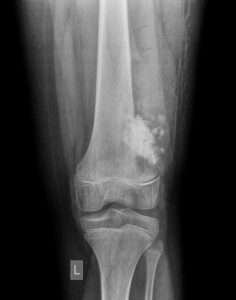
A 15-year-old male presents with progressive knee pain and swelling. The X-ray reveals a distal femoral lesion with cloud-like radiodensity and periosteal spicules.
What is the most likely diagnosis?
CorrectIncorrect -
Question 22 of 25
22. Question
Which of the following is the first-line treatment for gigantism caused by a pituitary adenoma?
CorrectIncorrect -
Question 23 of 25
23. Question
A 70-year-old man complains of gradual increase in hat size, bilateral hearing loss, and jaw discomfort. On oral exam, there is spacing between teeth and mild expansion of the maxilla.
What is the most likely underlying condition?
CorrectIncorrect -
Question 24 of 25
24. Question
A 35-year-old patient presents with episodic headaches, sweating, and palpitations. Blood pressure is consistently elevated. Which of the following is the most likely diagnosis?
CorrectIncorrect -
Question 25 of 25
25. Question
A 14-year-old boy is brought in with persistent, deep-seated pain in his right thigh for over a month. He has also had intermittent fevers and feels generally unwell. Laboratory investigations reveal leukocytosis, elevated ESR, and mild anemia. On examination, there is localized tenderness without swelling or erythema.
Radiographic imaging of the femur shows a diaphyseal lytic lesion with a laminated periosteal reaction. A biopsy reveals small round blue cells on histology.
What is the most likely diagnosis?
CorrectIncorrect