
Quiz Summary
0 of 25 Questions completed
Questions:
Information
You have already completed the quiz before. Hence you can not start it again.
Quiz is loading…
You must sign in or sign up to start the quiz.
You must first complete the following:
Results
Results
0 of 25 Questions answered correctly
Your time:
Time has elapsed
You have reached 0 of 0 point(s), (0)
Earned Point(s): 0 of 0, (0)
0 Essay(s) Pending (Possible Point(s): 0)
Categories
- Not categorized 0%
- 1
- 2
- 3
- 4
- 5
- 6
- 7
- 8
- 9
- 10
- 11
- 12
- 13
- 14
- 15
- 16
- 17
- 18
- 19
- 20
- 21
- 22
- 23
- 24
- 25
- Current
- Review
- Answered
- Correct
- Incorrect
-
Question 1 of 25
1. Question
A 9-year-old child has normal-looking permanent teeth, but radiographs show large pulp chambers with multiple pulp stones and a thistle-tube shape. What is the most likely diagnosis?
CorrectIncorrect -
Question 2 of 25
2. Question
Which of the following is the most appropriate indication for a strip crown in pediatric dentistry?
CorrectIncorrect -
Question 3 of 25
3. Question
A 7-year-old child presents with horizontal grooves and pits on the maxillary central incisors and first permanent molars. Which of the following is the most likely environmental cause?
CorrectIncorrect -
Question 4 of 25
4. Question
Which of the following is the most common cause of soft tissue trauma following local anesthesia in pediatric patients?
CorrectIncorrect -
Question 5 of 25
5. Question
A 10-year-old patient presents with normal-looking crowns but mobile teeth and premature exfoliation.
Radiographs reveal short roots with obliterated pulp chambers.
What is the most likely diagnosis?
CorrectIncorrect -
Question 6 of 25
6. Question
A 30-year-old patient requires root canal therapy on a mandibular molar. The radiograph shows an enlarged pulp chamber extending deep into the root with no clear pulpal floor. Which genetic syndrome is most commonly associated with taurodontism?
CorrectIncorrect -
Question 7 of 25
7. Question
Which of the following is a primary goal of conscious sedation in pediatric dentistry?
CorrectIncorrect -
Question 8 of 25
8. Question
Which of the following is the most characteristic clinical feature of dentinogenesis imperfecta?
CorrectIncorrect -
Question 9 of 25
9. Question
Which of the following syndromes is most commonly associated with multiple supernumerary teeth?
CorrectIncorrect -
Question 10 of 25
10. Question
During SSC preparation of a primary molar, which of the following is the correct occlusal reduction?
CorrectIncorrect -
Question 11 of 25
11. Question
What is the primary advantage of nitrous oxide over other sedatives in children?
CorrectIncorrect -
Question 12 of 25
12. Question
1 mm incisal reduction is typically required for preparation of which of the following pediatric restorations?
CorrectIncorrect -
Question 13 of 25
13. Question
Which of the following are characteristics of primary tooth anatomy?
CorrectIncorrect -
Question 14 of 25
14. Question
Congenital missing teeth are the result of failure in which stage of development?
CorrectIncorrect -
Question 15 of 25
15. Question
The enamel rods in the gingival third of primary teeth slope occlusally instead of cervically as in permanent teeth. The roots of primary teeth tend to be more divergent than those of permanent teeth
CorrectIncorrect -
Question 16 of 25
16. Question
Shields Type II dentin dysplasia is inherited in which of the following patterns?
CorrectIncorrect -
Question 17 of 25
17. Question
A 4-year-old child presents with an unusually large anterior primary tooth. Radiographic examination reveals that the tooth has two distinct pulp chambers and two root canals but appears as a single crown clinically. What is the most likely diagnosis?
CorrectIncorrect -
Question 18 of 25
18. Question
Which of the following is the most important consideration when preparing a Class II cavity in a primary molar?
CorrectIncorrect -
Question 19 of 25
19. Question
Which of the following systemic conditions is most commonly associated with generalized macrodontia?
CorrectIncorrect -
Question 20 of 25
20. Question
Order the four plateaus of stage I anesthesia (analgesia):
A. Drift
B. Paresthesia
C. Dream
D. Vasomotor
CorrectIncorrect -
Question 21 of 25
21. Question
Radiographic examination of a tooth reveals an invagination that extends through the root and exits at the apical foramen. The main pulp chamber remains vital, but there is a periapical radiolucency. What type of dens invaginatus is this?
CorrectIncorrect -
Question 22 of 25
22. Question
A 4-year-old child weighing 15 kg is scheduled for multiple restorations.
What is the maximum volume of 2% lidocaine with 1:100,000 epinephrine that can be safely administered?
CorrectIncorrect -
Question 23 of 25
23. Question
Which type of supernumerary tooth is typically peg-shaped and often causes delayed eruption of adjacent teeth?
CorrectIncorrect -
Question 24 of 25
24. Question
Which of the following is not a distinguishing feature of the primary maxillary canine compared to the permanent maxillary canine?
CorrectIncorrect -
Question 25 of 25
25. Question
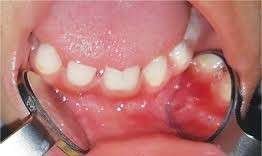
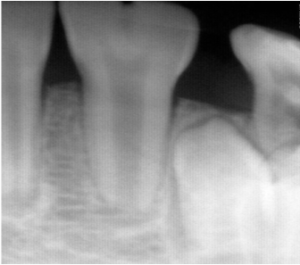
Based on the clinical and radiographic findings shown, which of the following is the most accurate diagnosis?
CorrectIncorrect