
Quiz Summary
0 of 25 Questions completed
Questions:
Information
You have already completed the quiz before. Hence you can not start it again.
Quiz is loading…
You must sign in or sign up to start the quiz.
You must first complete the following:
Results
Results
0 of 25 Questions answered correctly
Your time:
Time has elapsed
You have reached 0 of 0 point(s), (0)
Earned Point(s): 0 of 0, (0)
0 Essay(s) Pending (Possible Point(s): 0)
Categories
- Not categorized 0%
- 1
- 2
- 3
- 4
- 5
- 6
- 7
- 8
- 9
- 10
- 11
- 12
- 13
- 14
- 15
- 16
- 17
- 18
- 19
- 20
- 21
- 22
- 23
- 24
- 25
- Current
- Review
- Answered
- Correct
- Incorrect
-
Question 1 of 25
1. Question
What is the preferred medicament used in vital pulpotomy procedures for primary teeth?
CorrectIncorrect -
Question 2 of 25
2. Question
Pulpectomy in a primary tooth is most appropriate when:
CorrectIncorrect -
Question 3 of 25
3. Question
A 4-year-old falls and fractures the incisal edge of a primary maxillary central incisor.
There is a pinpoint pulp exposure, but no caries is present.
The child has no pain and radiographs are normal.
Which treatment option is most appropriate?
CorrectIncorrect -
Question 4 of 25
4. Question
What is the main concern with using formocresol in pulpotomy procedures?
CorrectIncorrect -
Question 5 of 25
5. Question
Which of the following are likely contraindications for performing a pulpotomy on a a primary molar?
CorrectIncorrect -
Question 6 of 25
6. Question
Which of the following indicates transition from gingivitis to periodontitis?
CorrectIncorrect -
Question 7 of 25
7. Question
Which of the following features is most characteristic of the initial stage of gingivitis?
CorrectIncorrect -
Question 8 of 25
8. Question
A 10-year-old child reports bleeding gums while brushing.
Clinical examination reveals generalized gingival inflammation, bleeding on probing, and visible soft deposits around the gingival margins.
What is the most likely diagnosis?
CorrectIncorrect -
Question 9 of 25
9. Question
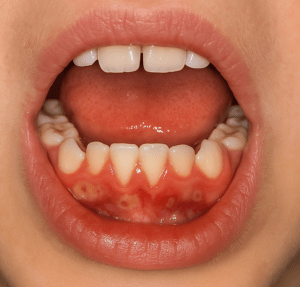
A 3-year-old child presents with sudden onset of fever, irritability, and painful, swollen gums.
Multiple small vesicles on the attached gingiva and oral mucosa have ruptured, leaving shallow ulcers covered by a grayish membrane.
The child also has difficulty eating due to pain.
What is the most likely diagnosis?
CorrectIncorrect -
Question 10 of 25
10. Question
Which of the following statements is true regarding the width of attached gingiva in children compared to adults?
CorrectIncorrect -
Question 11 of 25
11. Question
Which of the following are common causes of gingival recession in children?
(Multiple answer question)
CorrectIncorrect -
Question 12 of 25
12. Question
Which of the following best describes herpetiform aphthous ulcers?
CorrectIncorrect -
Question 13 of 25
13. Question
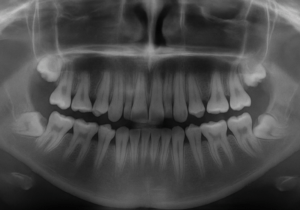
A radiograph shows vertical bone loss on the first molars and incisors in a 14-year-old patient.
The rest of the dentition shows no bone loss.
Which diagnosis is most likely?
CorrectIncorrect -
Question 14 of 25
14. Question
Which of the following are commonly associated with the development of acute necrotizing ulcerative gingivitis in children?
(Multiple answer question)
CorrectIncorrect -
Question 15 of 25
15. Question
Match the type of injury with the correct classification:
1.Enamel-dentin fracture
2. Avulsion
3. Concussion
4. Luxations
A) Mild
B) Moderate
C) MajorCorrectIncorrect -
Question 16 of 25
16. Question
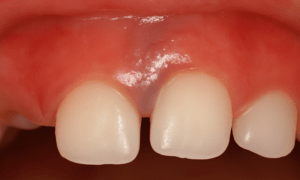
Which of the following best describes the injury?
CorrectIncorrect -
Question 17 of 25
17. Question
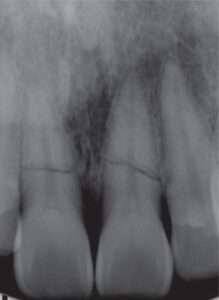
A 5-year-old child presents after a fall.
Clinical examination shows a mobile maxillary primary central incisor with slight coronal displacement.
A periapical radiograph reveals a horizontal radiolucent line in the middle third of the root, with the apical portion intact and in position.
What is the most appropriate treatment?
CorrectIncorrect -
Question 18 of 25
18. Question
A 5-year-old starts crying as the dentist picks up the mirror.
She doesn’t resist physically and opens her mouth when asked, though she continues to cry softly.
What is the most appropriate classification?
CorrectIncorrect -
Question 19 of 25
19. Question
A 7-year-old child presents with a persistent thumb-sucking habit, despite prior behavioral interventions.
On examination, the child exhibits a high-arched palate, proclined maxillary anterior teeth, and an anterior open bite.
What is the most appropriate next step in managing this patient?
CorrectIncorrect -
Question 20 of 25
20. Question
Which of the following best defines Early Childhood Caries (ECC)?
CorrectIncorrect -
Question 21 of 25
21. Question
Which of the following best describes the cause of the midline diastema during the ugly duckling stage?
CorrectIncorrect -
Question 22 of 25
22. Question
In the knee-to-knee position, how is the child typically placed?
CorrectIncorrect -
Question 23 of 25
23. Question
A pediatric patient is taking amphetamine. Which of the following is most likely to be noted in the patient’s health history?
CorrectIncorrect -
Question 24 of 25
24. Question
A 9-year-old child has lost both maxillary second primary molars prematurely. The first permanent molars have erupted. Which space maintainer is most appropriate to prevent mesial drift of the permanent molars?
CorrectIncorrect -
Question 25 of 25
25. Question
A child enters the dental clinic crying, refuses to sit on the chair, and clings tightly to the parent. According to Frankl’s scale, this behavior is classified as:
CorrectIncorrect